


How lenders translate your score into a rate
When you submit an auto loan application, the lender pulls your credit report and score almost immediately. That number does not just trigger an approve-or-deny decision. It places you into a rate tier, a bracket that determines the annual percentage rate (APR) attached to your offer.
Lenders build their own tier structures, but most follow a rough pattern tied to standard score ranges. Borrowers with scores above 720 or 740 typically land in the most favorable tier and receive the lowest rates a lender advertises. Scores in the 660-to-720 range usually land in a mid-tier, with rates a few percentage points higher. Below 620, borrowers often face rates that are substantially higher, and some conventional lenders may decline the application entirely.
Because each lender sets its own cutoffs, the same score can put you in different tiers at different institutions. That is one reason comparing offers from multiple sources before committing matters. See our step-by-step preapproval walkthrough for guidance on collecting and comparing those offers.
This article is general financial information and education. It is not personalized financial or lending advice. Consult a qualified financial adviser or licensed lending professional for guidance specific to your situation.
What the rate difference costs over time
A few percentage points in APR may look small on paper, but the dollar impact over a 60- or 72-month loan term is real. On a $28,000 loan at 5% APR, a borrower pays roughly $3,700 in total interest over 60 months. At 12% APR on the same loan, that figure rises to about $9,100. The vehicle price did not change; only the rate did.
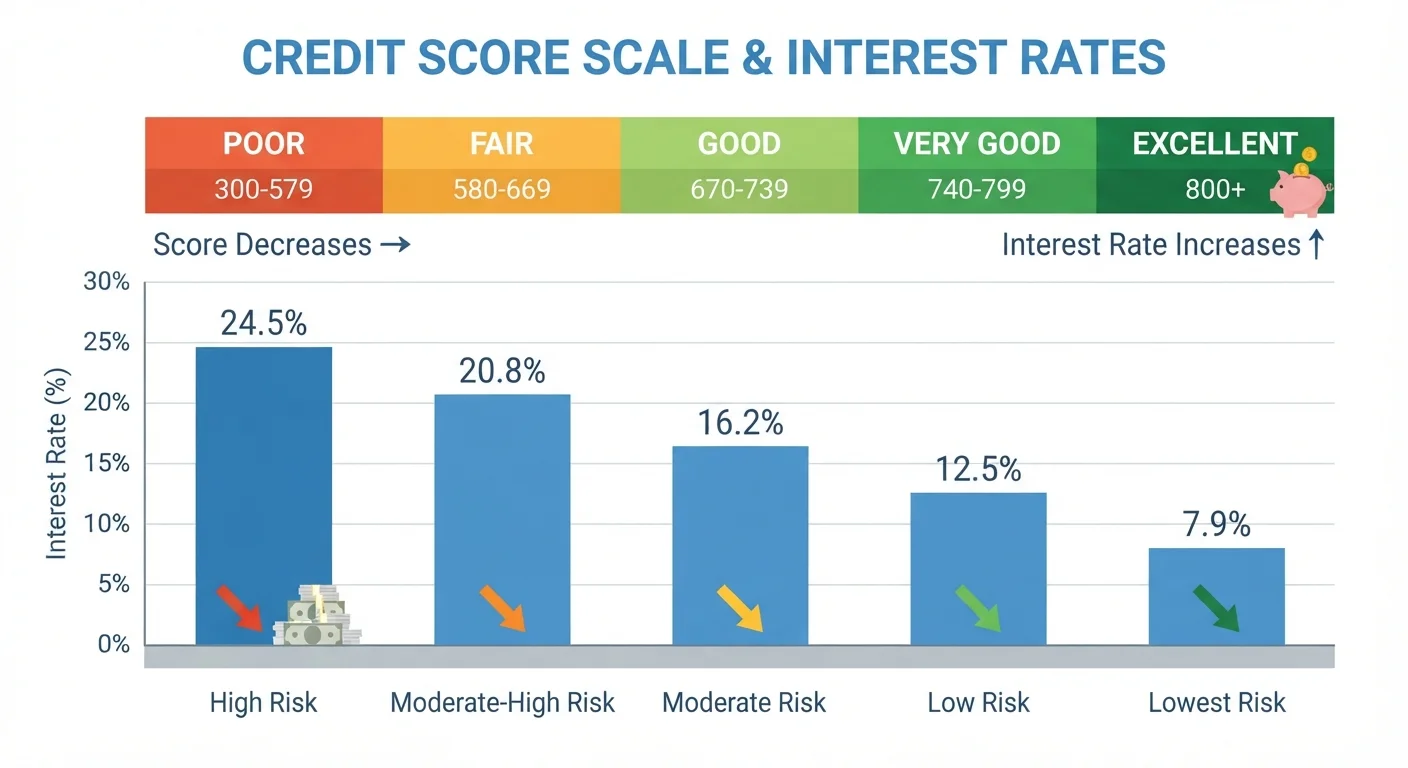
This gap also shows up in the monthly payment. A higher APR means a higher required payment for the same loan amount and term, which affects how much vehicle a borrower can realistically afford. Understanding how APR, interest rate, and loan term interact is worth doing before you calculate a budget. The article APR, interest rate, and loan term explained breaks down each number in plain language.
300-850
Standard FICO and VantageScore range
Both major scoring models use this range. Auto lenders typically define their own tier cutoffs within it, which vary by institution.
~4-10+ pts
Typical APR gap between top and bottom credit tiers
The spread between the rate offered to prime borrowers and subprime borrowers on auto loans has historically ranged from roughly 4 to more than 10 percentage points, depending on market conditions and lender policy.
72 months
Common maximum loan term offered
Many lenders offer terms up to 72 or 84 months. Longer terms lower the monthly payment but increase total interest paid, compounding the cost of a higher APR.
The score factors that move your number most
FICO scores and VantageScores both use five broad categories, though they weight them somewhat differently. Payment history carries the most influence in both models. A single missed payment can drop a score meaningfully, and the effect lingers on your report for up to seven years.
Credit utilization, the share of your revolving credit limits you are currently using, is the second-largest factor. Carrying balances near your credit card limits tends to pull scores down. Paying those balances below 30% of each limit, or lower if possible, can raise your score before you apply for a loan.
The length of your credit history, the mix of account types you carry (installment loans, revolving credit), and recent applications for new credit round out the remaining factors. For borrowers who are new to credit or rebuilding after past problems, auto loan basics for first-time borrowers covers what lenders examine beyond just the score itself.
Checking your report before you apply
Errors on credit reports are more common than many borrowers expect. A account that does not belong to you, a payment incorrectly marked late, or a balance that was paid off but still shows as open can all suppress your score. Federal law gives consumers the right to request free credit reports from each of the three major bureaus (Equifax, Experian, and TransUnion) through AnnualCreditReport.com.
Reviewing your report at least 60 days before applying gives you time to dispute errors and see corrections reflected before a lender pulls your file. Disputes can be filed directly with each bureau and with the furnisher that reported the inaccurate information.
Your credit score also factors into costs beyond the loan itself. In most states, insurers use credit-based insurance scores when setting premiums. The article how your credit score factors into auto insurance pricing explains how that practice works and what it may mean for your coverage costs.