


What each number actually means
When a lender quotes you a rate, that number is the interest rate: the annual percentage charged on the amount you borrow. If you borrow $20,000 at a 7% interest rate, the lender calculates daily or monthly interest on your remaining balance at that rate.
APR (Annual Percentage Rate) takes that interest rate and adds any fees the lender charges to arrange the loan. On auto loans, common fees include origination or documentation charges. When those fees exist, APR will be higher than the stated interest rate. When there are no fees, the two numbers are identical. Because APR captures the full cost in one figure, it is the better number to use when comparing offers from different lenders.
The loan term is simply how many months you have to repay. Common auto loan terms run 24, 36, 48, 60, 72, or 84 months. The term does not change your rate, but it changes how much total interest you pay and what your monthly payment is.
If you are new to auto financing, the auto loan basics guide covers how lenders evaluate applications and what to expect before you sign.
How term length shifts the math
Consider two loans for the same $20,000 principal at the same 7% APR. A 48-month term produces a monthly payment around $479 and total interest of roughly $1,990. A 72-month term drops the monthly payment to about $333, but total interest climbs to approximately $3,990. The monthly savings of $146 costs an extra $2,000 over the life of the loan.
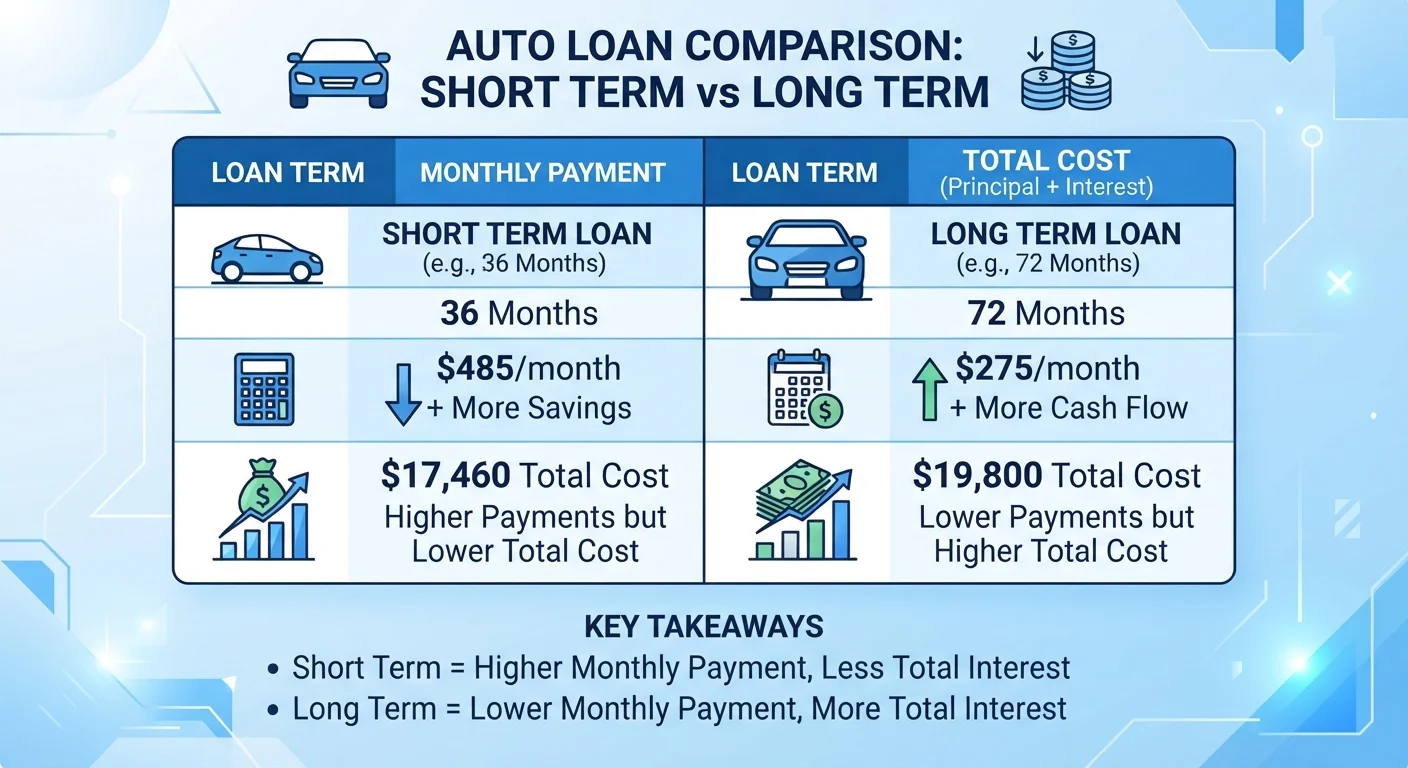
This trade-off matters most for budget-focused buyers. A lower payment can fit a tighter monthly budget, but it means the vehicle costs more over time and you build equity in it more slowly. For used vehicles especially, a long loan term can leave you owing more than the car is worth for several years. The used car financing explainer goes deeper on how lenders treat pre-owned vehicles differently.
Paying more per month than the minimum due is one way to reduce total interest without committing to a shorter term from the start.
$2,000+
Extra interest on 72-month vs. 48-month loan
Illustrative example: $20,000 principal at 7% APR, comparing 48-month and 72-month terms.
72 months
Most common extended auto loan term offered
72- and 84-month terms have become widely available from banks, credit unions, and dealership financing arms.
Where your credit score fits in
The interest rate a lender offers is not fixed for everyone. Lenders set rates based partly on the borrower's credit score, which signals how likely they are to repay the loan on time. A borrower with a score in the mid-700s will generally receive a lower rate than a borrower in the mid-600s, even from the same lender on the same loan amount.
A one or two percentage point difference in rate may look small, but on a $25,000 loan over 60 months, it can translate to several hundred dollars in extra interest. Understanding how your credit score shapes every loan offer you receive helps you know what range of rates to expect before you apply.
This article provides general financial information for educational purposes only and is not personalized financial or lending advice. Loan terms, rates, and eligibility vary by lender. Consult a licensed financial professional for guidance specific to your situation.