

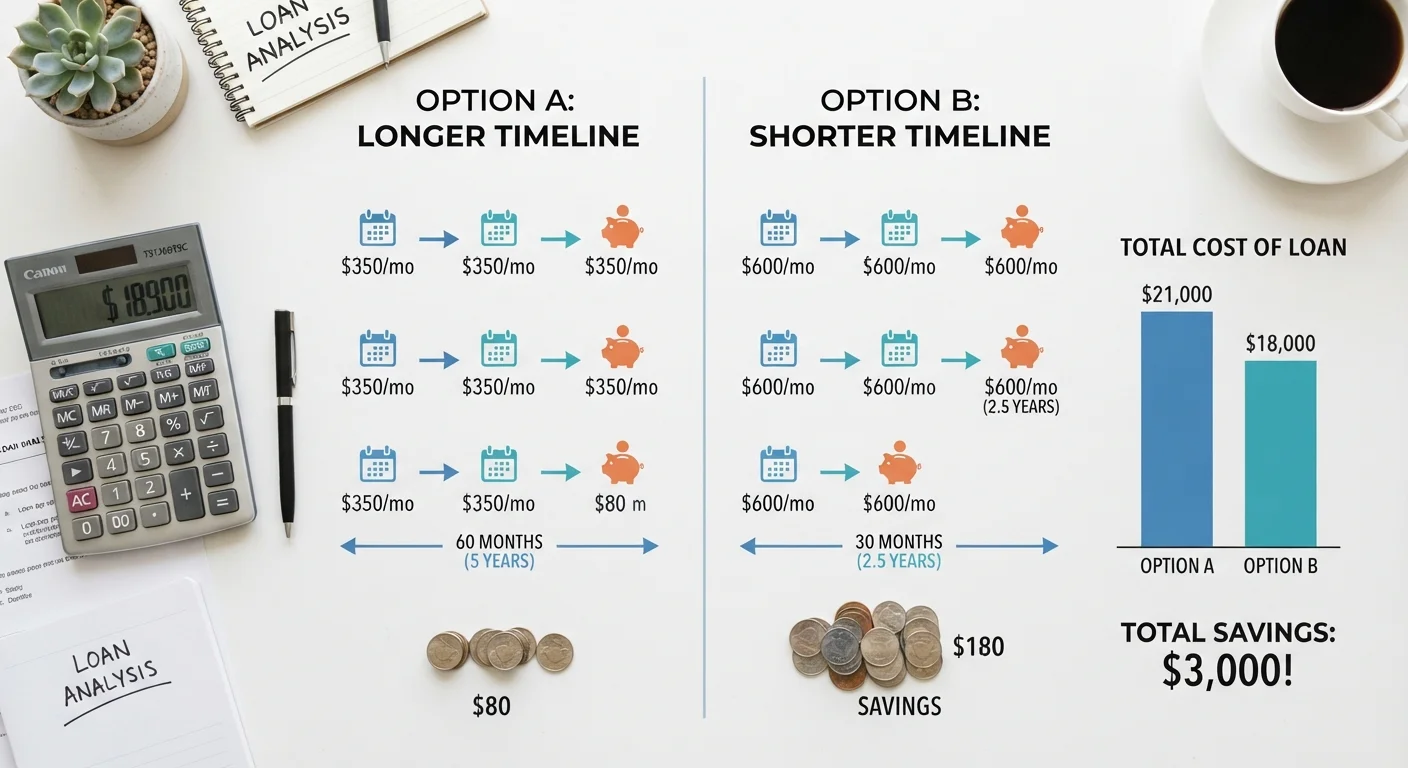
The monthly payment trap
When shoppers evaluate an auto loan, the monthly payment number tends to dominate the conversation. That makes sense: it is the figure that has to fit a monthly budget. But a payment that feels manageable can mask a loan that is expensive overall.
The reason comes down to how interest accrues. Each month, the lender calculates interest on your remaining balance. A longer loan term means that balance shrinks slowly, so interest has more billing cycles to add up. By the time the loan is paid off, borrowers who chose the comfortable monthly payment may have paid significantly more than those who took a shorter, tighter loan on the same vehicle.
This is worth understanding before you sit down with a lender, not after. Common auto loan misconceptions often start here: the assumption that the monthly number is the real cost of the loan.
How amortization works against a long term
Auto loans use a structure called simple interest amortization. Each payment covers that month's interest first; whatever remains reduces the principal. Early payments are weighted heavily toward interest, which is why the balance drops slowly at first even when you pay on time every month.
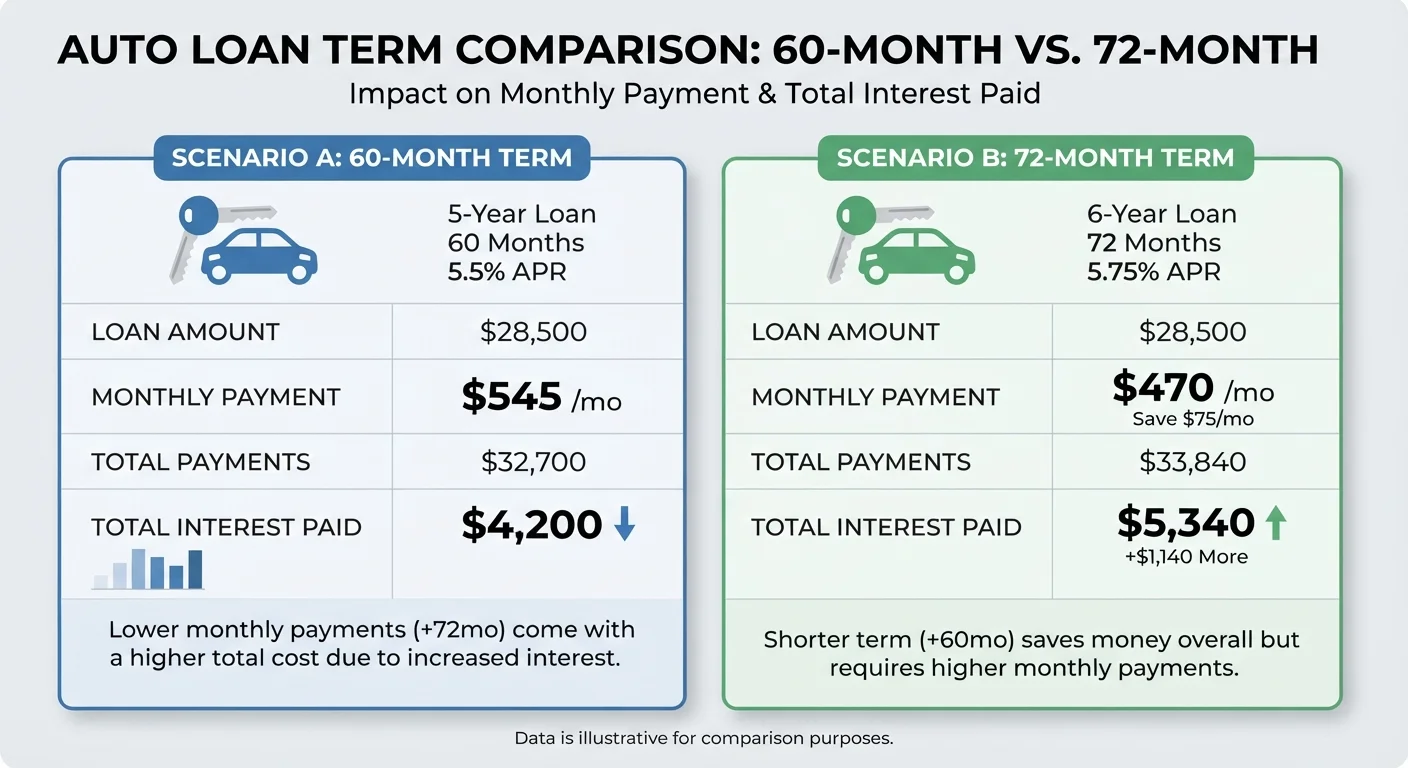
Consider a concrete illustration. On a $25,000 loan at 7% annual interest, a 48-month term produces a monthly payment of roughly $598 and a total repayment of about $28,700. The same loan stretched to 72 months brings the monthly payment down to about $432, but total repayment climbs to roughly $31,100. The 72-month borrower pays approximately $2,400 more for the same vehicle and the same loan amount, simply by choosing a longer term.
Comparing short and long auto loan terms in detail shows how this math shifts across different rate environments and loan sizes.
$2,400+
Extra interest on a 72-month vs. 48-month loan
Illustrative calculation on a $25,000 loan at 7% APR; actual amounts vary by rate and lender.
72 months
Most common long-term auto loan length offered by lenders
Six-year terms have become standard offerings at many U.S. banks, credit unions, and dealership finance departments.
~30%
Share of early payments that go to principal on a long-term loan
On a 72-month loan at moderate rates, a large portion of early payments covers interest before reducing the balance significantly.
When a higher payment makes financial sense
Choosing a shorter loan term is not the right move in every situation. Missing a payment, or stretching a budget so thin that other bills fall behind, carries its own financial costs. The question is whether the monthly difference is genuinely unmanageable or simply unfamiliar.
A useful exercise: calculate the total repayment cost for two or three term options before agreeing to any of them. That figure, principal plus all interest paid, is what the loan actually costs. Many borrowers find that the gap between a 48-month and a 60-month option is a few dollars per month but hundreds of dollars in total interest. That reframe changes how the choice looks.
For buyers considering used vehicles, loan terms matter even more because lenders sometimes charge higher rates on older models. How used car financing works covers how lenders evaluate vehicle age and what that means for rates and terms.
Reducing interest without refinancing
Borrowers who have already taken a longer loan are not locked in permanently. Making additional principal payments when budget allows shortens the effective loan term and reduces total interest. Even one extra payment per year can have a measurable effect over a 60- or 72-month loan.
Before making extra payments, verify that the loan has no prepayment penalty. Some contracts include clauses that charge a fee for early payoff. Reading the key clauses in a loan agreement before signing is the most reliable way to avoid that surprise.
Compare total repayment, not just monthly cost
Before accepting any loan offer, multiply the monthly payment by the number of months to find the total repayment figure. Subtract the loan principal to see exactly what the interest will cost you. This calculation takes about 30 seconds and gives you a much clearer picture of what each option actually costs.
This article provides general financial education about auto loan structures and is not personalized financial advice. Loan terms, interest rates, and total costs vary by lender, credit profile, and individual circumstances. Consult a licensed financial professional for guidance specific to your situation.