


Why the fine print changes your total cost
An auto loan contract is a legal document, and every section carries financial weight. The interest rate and monthly payment get most of the attention during shopping, but several clauses buried further into the agreement can cost you hundreds or thousands of dollars if you miss them. Before you sign, review the fundamentals of how auto loans work so you can read the contract with context.
The clauses covered below appear in most U.S. auto loan agreements, though exact wording and terms vary by lender. This article is general financial education, not personalized legal or financial advice. For questions specific to your contract, consult a licensed financial adviser or attorney.
| Governing federal law | Truth in Lending Act (TILA), Regulation Z (U.S. Consumer Financial Protection Bureau) |
| Required disclosures before signing | APR, total finance charge, payment schedule (TILA, 15 U.S.C. 1601 et seq.) |
| Typical auto loan term range | 24 to 84 months (Common U.S. lender practice) |
| GAP cancellation window | Varies by lender; often 30 to 60 days (Check your specific addendum) |
| Force-placed insurance trigger | Lapse in required comprehensive/collision coverage (Standard lender contract language) |
| Prepayment penalty prevalence | Less common at credit unions; more varied at finance companies (General U.S. lending practice) |
The clauses that carry the most financial risk
Prepayment penalty clause
Some lenders charge a fee if you pay off the loan early, because early payoff cuts into the interest they expected to collect. This clause may appear under "prepayment," "early termination," or "payoff" language. If the contract includes a prepayment penalty, calculate whether paying off early still saves money after the fee. Many lenders, particularly credit unions and larger banks, do not charge prepayment penalties, but the contract is the only authoritative source for your specific loan.
APR disclosure and finance charge total
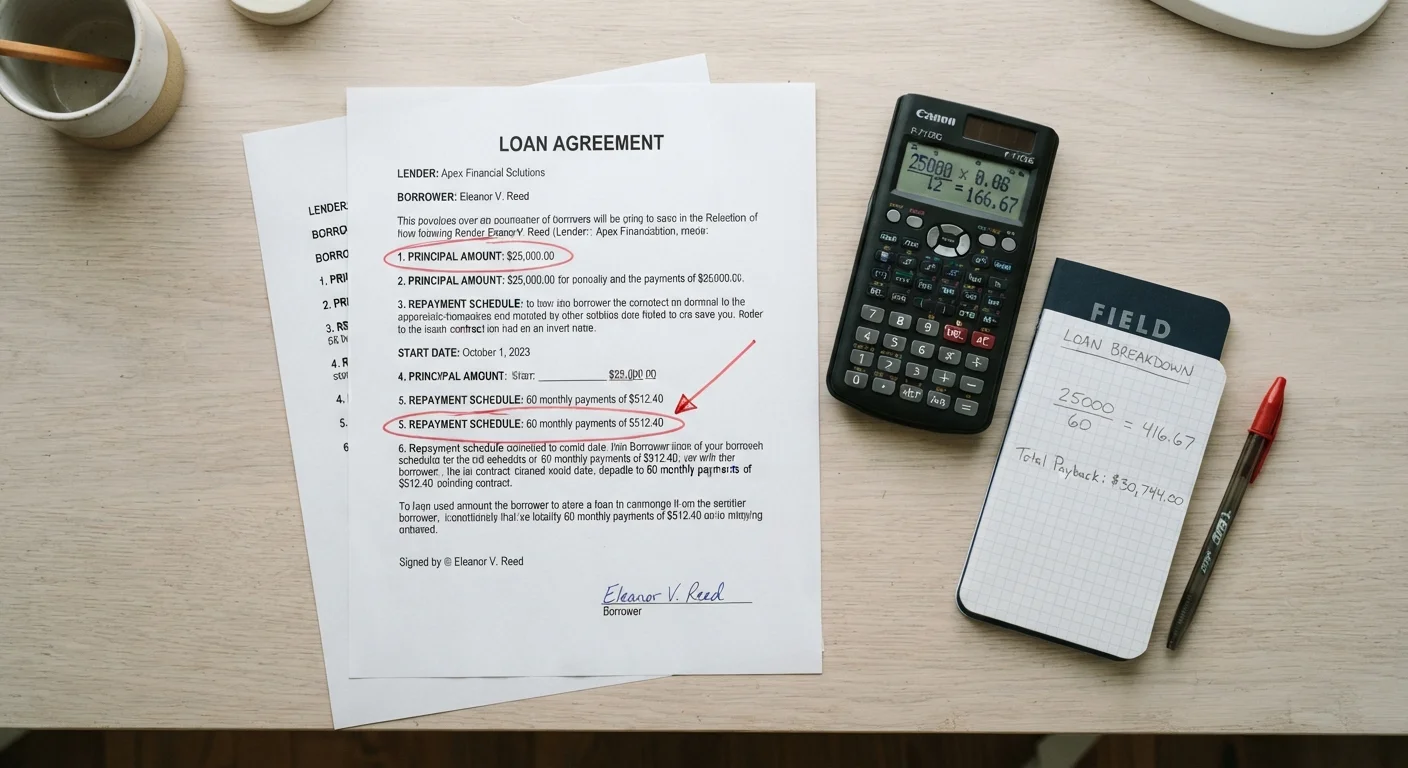
Federal law (the Truth in Lending Act) requires lenders to disclose the annual percentage rate (APR) and the total finance charge before you sign. The APR includes the interest rate plus most fees rolled into the loan, so it reflects the true yearly cost better than the interest rate alone. Check that the APR in the contract matches what you were quoted. A discrepancy, even a small one, adds up over a 48- or 72-month term.
Default and acceleration clause
A default clause defines what actions trigger a default, which can include missing a payment, letting your insurance lapse, or in some contracts, any change in your financial circumstances the lender deems material. An acceleration clause allows the lender to demand the full remaining loan balance immediately upon default. Read both sections together to understand exactly what protections you need to maintain throughout the loan term.
Force-placed insurance clause
If your auto insurance lapses, many lenders have the right to purchase insurance on the vehicle and add the premium to your loan balance. Force-placed insurance is typically more expensive than a standard policy and covers only the lender's interest in the vehicle, not yours. Keeping continuous coverage is the straightforward way to avoid this clause being triggered. The auto insurance hub covers what coverage options American drivers generally carry.
GAP waiver or addendum
If the contract includes a GAP (Guaranteed Asset Protection) product, it will appear as an addendum with its own cost disclosed separately. GAP covers the difference between what you owe on the loan and what your insurer pays if the vehicle is totaled or stolen. Whether GAP makes financial sense depends on your down payment, loan term, and vehicle depreciation rate. The addendum should state the cost and cancellation terms clearly; you generally have the right to cancel within a specific window for a refund.
Fee schedule
Look for a line-by-line list of fees: origination fees, documentation fees, title fees, and any dealer-added fees that were folded into the loan amount. Some fees are negotiable before signing; once the contract is executed, they are not. Common misconceptions about auto loan costs often involve fees that buyers did not expect because they focused only on the monthly payment.
How to work through the contract systematically
Request a copy of the full contract before your signing appointment, not just the payment summary. Read it away from the dealership, where time pressure is absent. Write down any clause you do not understand and ask the lender or a licensed adviser to explain it before you sign. If any term differs from what you were verbally quoted, ask for a written correction. Used car financing agreements can include additional clauses related to vehicle condition disclosures, so the same careful review applies there.
This article provides general financial information for educational purposes only. It is not personalized financial, legal, or contractual advice. Loan terms, fees, and clauses vary by lender and by state. Read your specific contract documents carefully and consult a licensed financial adviser or attorney before making decisions based on your individual circumstances.