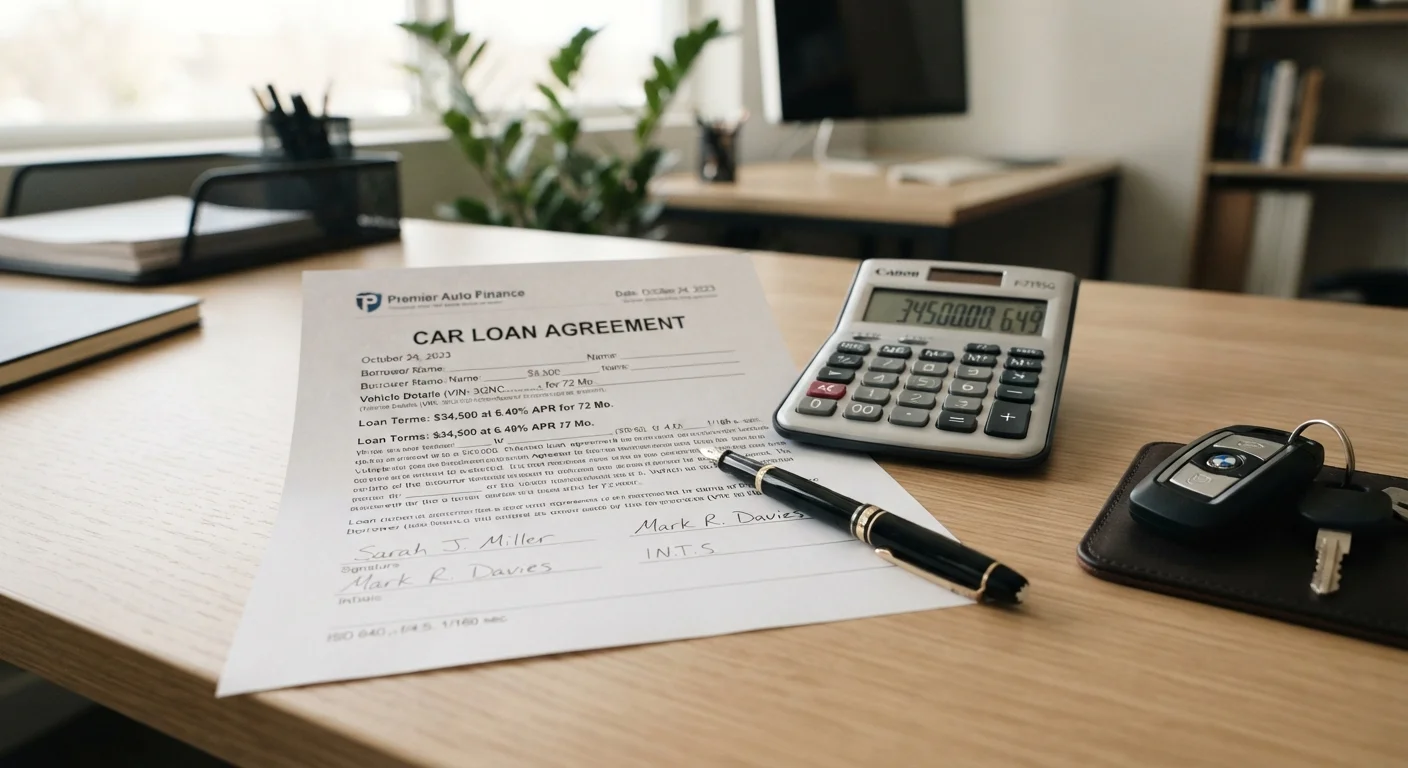
Walk through the documents, numbers, and questions you should have ready before applying for an auto loan so nothing catches you off guard.
Key Takeaways
Pull your credit report before applying so errors do not cost you a higher rate.
Lenders look at debt-to-income ratio, so calculate yours ahead of time.
Knowing your budget ceiling before shopping prevents you from overcommitting on a monthly payment.
Preapproval from a lender gives you a rate benchmark before you visit a dealer.
Having your income and identity documents ready speeds up the application process.
Loan term length affects total interest paid, not just the monthly payment.
What this checklist covers
Applying for an auto loan without preparation can slow your approval, cost you a higher interest rate, or result in a loan amount that does not match your actual budget. This checklist walks through four areas: your credit profile, your income documents, your budget math, and your loan questions. Work through each group before you submit any application.
Lenders typically ask for proof of income, a valid ID, and proof of residence at minimum.
The pre-application checklist
Work through each group below. Items marked must are non-negotiable for most lenders. Items marked should are strongly recommended and often affect your rate or approval speed.
Credit profile
Pull your credit reports from all three bureaus (Equifax, Experian, TransUnion) at least two weeks before applying so you have time to dispute any errors.Must
Note your credit score range, since lenders use it to determine the interest rate tier you qualify for.Must
Check for accounts listed as open that you have already closed, and verify that balances on revolving accounts are reported accurately.Should
If your score is lower than you expected, check whether a recent missed payment or a high credit utilization rate is the cause before applying.Should
Income and identity documents
Gather your two most recent pay stubs if you are a salaried or hourly employee; lenders use these to verify gross monthly income.Must
If you are self-employed, prepare your two most recent federal tax returns and a recent bank statement showing consistent deposits.Must
Have a valid government-issued photo ID ready, such as a driver's license or passport.Must
Prepare proof of current address, typically a utility bill or bank statement dated within the last 60 days.Must
If you receive Social Security, pension, or disability income, gather award letters or benefit statements showing the payment amount.Should
Budget math
Calculate your debt-to-income ratio (DTI) by dividing your total monthly debt payments by your gross monthly income; most lenders prefer a DTI below 43 percent.Must
Set a monthly payment ceiling based on your take-home pay, not gross income, so the payment is one you can actually cover each month.Must
Estimate your total purchase budget by accounting for the down payment, any trade-in value, taxes, title fees, and registration costs, not just the vehicle price.Must
Run the numbers on loan term options: a 48-month term costs more per month but less in total interest than a 72-month term on the same principal.Should
Check whether you have funds set aside for the first insurance payment, since lenders require proof of coverage before releasing funds.Should
Loan questions to answer before you apply
Decide whether you want to apply through a bank, credit union, or online lender before visiting a dealership, so you have a rate to compare against dealer financing.Should
Ask each lender whether their preapproval involves a hard credit inquiry or a soft pull, since multiple hard inquiries within a short window are typically counted as one by scoring models.Should
Confirm whether the lender charges a prepayment penalty if you pay off the loan early.Should
Find out the lender's minimum and maximum loan amounts to make sure your target vehicle price falls within their range.Nice to have
Ask about any rate discounts for automatic payment enrollment, which some lenders offer.Nice to have
If you plan to finance a used vehicle, note that lenders assess pre-owned cars differently than new ones. Used Car Financing Explained covers how loan-to-value ratios and vehicle age factor into lender decisions.
Using your preparation once you apply
Once your documents are in order and your budget math is done, the next step is getting preapproved. Getting Preapproved for an Auto Loan explains how to apply for preapproval, what lenders review, and how to use the offer as a negotiating reference at the dealership.
After preapproval, you will eventually receive a loan agreement to sign. Loan contracts include clauses on prepayment penalties, default terms, and fees that are easy to overlook. Reading an Auto Loan Agreement: The Clauses That Matter Most identifies the sections that carry the most financial risk.
Some common beliefs about auto loans, such as the idea that preapproval harms your credit score, can lead buyers to skip useful steps. Auto Loan Misconceptions That Trip Up Budget-Conscious Buyers addresses those misunderstandings with straightforward answers.
This article provides general financial information for educational purposes only and is not personalized financial or legal advice. Loan terms, eligibility, and rates vary by lender and individual circumstances. Consult a qualified financial adviser for guidance specific to your situation.
Auto Loans Editorial Team is the collective byline for our editorial team and contributor network. Articles published under this byline or an editorial pen name are researched, written, and reviewed according to our editorial standards for clarity, consistency, and independence before publication.
The content provided on our blog site traverses numerous categories, offering readers valuable and practical information. Readers can use the editorial team’s research and data to gain more insights into their topics of interest. However, they are requested not to treat the articles as conclusive. The website team cannot be held responsible for differences in data or inaccuracies found across other platforms. Please also note that the site might also miss out on various schemes and offers available that the readers may find more beneficial than the ones we cover.